Here it is!

Beating The Flyer

by Thomas B. Hallock

as told to Tay Hohoff

Sports Illustrated January 2, 1956

There was a month or so most years, back in the last century, when the people in the Hudson River Valley were isolated, town from town and even farm from farm. Early in the winter, the floating ice began coming down river, and gradually the cakes froze together into blocks of anchor ice – the first stage of the river’s closing. The great expenses of ice became a playground, and ice boating its most exciting and fastest sport. The racing boats could jump six feet of open water while traveling at only a fair speed, tack down wind 2 to 4 times faster than the wind itself and obey the merest hint from the tiller. No one then thought about clocking times. Competition was direct and simple: the Clark’s boat beat the Young’s and never mind the details.

Most of the ice boats were homemade, sloop rigged with a big spread of canvas. They were tricky to handle because tides, winds and storms were constantly affecting the condition of the ice. The boom was set higher than an ordinary sailboat, and the tiller post rose high enough to project the tiller over the steersman, who usually lay prone in the diamond shaped or rectangular basket. When brought sharply around on a tack, ballast was needed to weigh down the runners and that was where we younger boys came in. Four or five of us, one on each side of the mast and two at the outer edge of the cross piece, did the job. We perched on a plank about 15 inches wide: a freezing, perilous roost. We had to know when to move and then move fast. When a sharp turn was made in a high wind, all of us might be huddled together at the extreme tip of the plank, and why we didn’t fall off getting there no one knew. Boys seem to have an uncanny sense of balance.

Rome, a young swashbuckler, cherished what to me ( I was 10) seemed a glorious ambition: to race his boat against the Albany Flyer. The only railroad in those days ran along the river’s east shore, which was level and low and almost straight. Trains could build up tremendous speeds, and the crack of them all was the Albany Flyer.

We four boys who made up Rome’s crew would watch the Flyer go by and yell yeah! and thumb our noses at the engineer. We were torn between longing for the weather to break and fear of what would happen when it did, because everybody in the community was laughing at Rome’s boast. But there came a day at last when a strong, steady wind began to blow from the south, and the instant school was dismissed we tore down to the river. Rome ordered us to our places, and in a few long easy tacks we ran down river to the starting point below Marlborough. The runner gripped beautifully on slightly granular snow ice, the wind blew steadily a few points east of south directly on the course of the river, and we yelled and clowned on the cross piece until Rome brought the boat smartly around, let the sails flutter and turned the tiller at right angles to the backbone so that the runner bit sharply into the ice as an anchor.

We kept our eyes on the slow curve of Low Point, now called Chelsea, tensing as the first puffs of smoke rose over the tracks. When the train thundered over the Wappinger Creek trestle, we looked at Rome. He dressed the sails and flung himself down by the tiller. We were off.

The wind caught the sails full and strong, the runner bit into the ice, setting up a constant vibration, broken only when it cut through or jumped over frozen chunks. The train, going at more than 50 miles an hour, drew level with the boat. A visor-capped head appeared out of the engine cab. The trainman’s expression was scornful. Or so we imagined.

Rome was following the main channel, avoiding the shallow water by the east shore, for winds from the north or south seemed to blow strongest where the deep water ran. The noise of the train roared in our ears, almost indistinguishable from the wind. The boat speed began to pick up, and the engineer looked out again, with more interest. Soon smoke, thicker and blacker than before, began pouring out of the stack, and the wheels turned faster.

We yelled. It seemed we weren’t on the river at all, but were flying through air. At Blue Point the treacherous, ever-shifting crack stretched from shore to shore. Because a strong ebb tide was running, there were no piled up masses of ice to jump, but instead there was open water – in some places 10 feet wide.

It was up to us on the plank to decide where to cross. Standing up, gripping the mast or the stays, we strained to see ahead. In one place there was comparatively smooth ice on either side of the crack, and no more than three or four feet of water between. I signaled in that direction, and Rome headed for the level spot. If the wind held, we would make it; and any case, there was no time for a second thoughts. Instinctively, we cringed. There was a lift, a splash, and a deluge of freezing water as the plank and runner dipped, a bump, and we were over.

Beyond the point, the river widened. On the east rose a line of furnace chimneys, and by the time we could breathe again after our drenching, the Flyers black plume, abreast of us was, was mingling with the smoke and flame from the Phoenix Horseshoe Works. Ahead, the abutments of the future railroad bridge rose like cairns above the ice, a menace to the flying ice boat. For as the tide shifted, the ice broke up and piled against them, leaving open water where it was least expected. Our boat hit the first hump at a speed which nearly knocked us off our icy perch. She jolted, creaked and lost precious speed; but she got through safely onto the smoother ice off of Lange Rak (Long Reach), and we flew on, still hopeful of victory.

Time had ceased to be measurable. The 9 mile run might’ve lasted a minute or an eternity. We had lost flight of the train, which might’ve been halfway to Albany. Rome let the sail slack off, and the boat slowed to a stop. And where the tracks curved back to the rivers edge, there came the Flyer. We had won. We fell off the plank, shaking with cold and excitement, and jumped up and down, yelling and waving like lunatics. From the engine cab bare heads poked out while the whole crew waved their caps and shouted, though the sound was lost on the wind. The whistle blew a special blast, and as the last car passed us, a portly, blue uniformed man on the back platform raised his arm in salute. We were the happiest boys in New York State.

Posted in 2024 Season | Leave a comment

The Greatest Iceboat Race

In 1956 Sports Illustrated located and interviewed one of the survivors of the iconic race between train and ice yacht immortalized by Currier and Ives.
Here is his story.

Posted in 2024 Season | Leave a comment

“Line Em Up”

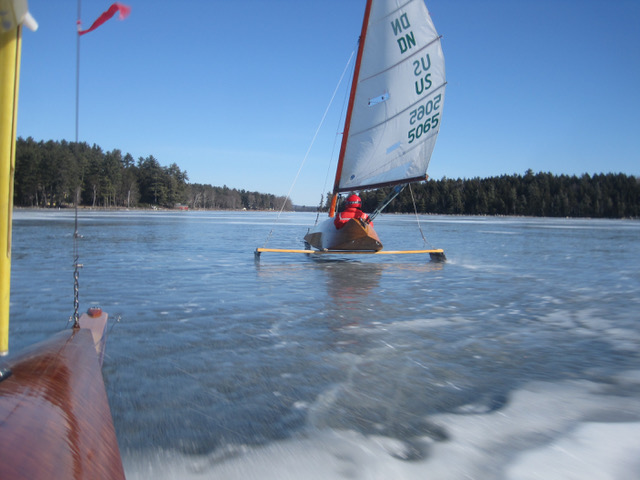
I met Lloyd when built my first Iceboat, a DN. And DNs are all about racing, so that was when I found the Chickawaukee Ice Boat Club. We raced almost every weekend, we had many named races, and if one of those was not on the calendar we would scratch race. We raced wherever there was good snow free ice, and much of the time that was Chickawaukee as it was near the coast. We had a good number of DNs on the line, and some very competitive racing. Lloyd was a serious DN racer and he was one of the competitors that believed in sharing the winning ways. I remember that he started the custom of the winner writing a piece for the CHICKAWAUKEE ICE RACER. That skipper would describe what it was that gave him the speed to win. It may have been tactics, runners, sail choice, WHATEVER. But it was about sharing, and the idea was to make everyone faster and more competitive, resulting in better racing.
I think of Lloyd every day when I do my daily calisthenics, of course do them for several reasons, one of them being to stay in condition for DN ice sailing of course. Several of the exercises that I do, work to strengthen my neck muscles, a very necessary strength when sailing DNs. I will always remember Lloyd would share his knowledge for most everything in what started out as the CHICKAWAUKEE ICE RACER and was sometimes titled the CHICKAWAUKEE ICE SAILOR. He shared most anything from plank construction and stiffness desired, and Larry Hardman ice poetry. Also good ways for you to maintain good strong neck muscles for sailing those mile long DN race laps on your back deciding when to tack onto the layline for the windward mark. I remember one of his suggested methods for neck muscle exercise was that if you were going to waste time watching television, do so on the floor lying flat on your back wearing your helmet as if in a DN, with no pillow allowed. My exercise routine includes many exercises that I do for iceboat fitness, several for my neck, and I have to say that I am thinking of Lloyd when I do them.
Not only was Lloyd a competitive sailor on the ice, he was an excellent writer, historian, and quite funny when he had a mind to be. I found the spring 2009 newsletter with the cover photo, SPRING SAILING FUN, GUARANTEED TO THRILL! There is a young lady sailing with a swastika on her shirt. His caption reads: THIS WINSOME LASS IS PROBABLY FROM GERMANY IN THE LATE 1930’s DURING THE HEYDAY OF GERMANY’S NATIONALISM. His Chickawaukee ice racers were always exciting to get in the mail, a never-ending supply of Chickawaukee race results, go fast tips and sailing history.

I already miss you Lloyd, Dave DN4690
Posted in 2024 Season | Leave a comment

Service at Lloyd’s House

Thanks to everyone who sent their kind remembrances of Lloyd Roberts. Without a question iceboating would be nowhere near the success is it today in Maine without him. I met Lloyd on Chickie when I was a skate sailor. The DN’s looked so appealing, sailing fast upwind, laying down! I reached over to a group of them, just standing around as I learned later they are wont to do, and began chatting with the tall guy. He was interested in my sail and before I knew it stuffed his GPS into my top pocket and said “Let’s see how fast that thing will go!” I liked him immediately.
He went on to become a major mentor in my development as a sailor and builder. Not only would Maine not be where it is today, I wouldn’t either.

Please note at the bottom of the obituary that there will be a gathering. The iceboaters are being asked to cast some of his ashes into the lake. We had many supreme sails from Roberts Beach over the years. Baked beans and hot chocolate over the fire never tasted so good.

ROCKPORT — Lloyd Roberts, 92, beloved husband, father, grandfather and friend, died on August 12 during the total solar eclipse, after having endured a series of strokes. Lloyd grew up in the suburbs of Boston attending the Fenn School and Middlesex School, where he excelled at science and math. He went on to higher education at Harvard University and Tufts Medical School. Many of his summers from childhood on were spent on the island of Vinalhaven.

In September of 1952, at the Harvard-Radcliffe Freshman mixer, he met his future wife, Marjorie Force Roberts. They married in 1955, 71 years ago. She was by his side when he passed peacefully in his sleep.

After residency, he entered the Air Force and was stationed as a pathologist at Langley Air Force Base in Virginia. He then finished his training at Lackland Base in San Antonio, Texas, where he both learned to fly and started a home-built plane

He and his wife moved their growing family (four children, cats, and a dog) from Texas to Alexandria, Virginia; Cooperstown, New York; and finally Maine where he started at the Knox hospital soon to become PenBay Medical Center. There he enjoyed being close to his family home on Vinalhaven.

The Roberts family moved first to Camden and eventually to a house on Chickawaukie Lake in Rockport where he could indulge his love of rowing in summer and ice-boating in winter. He continued to engage in his other favorite pastimes of model airplanes and shooting clay pigeons up until his last few months.

He is survived by his wife, Marjorie; daughters Abigail Fuller and Rebecca Vose; son, Sumner Roberts; and grandson, Nicholas Fuller, who had moved in to support Marjorie and Lloyd in his wish to pass quietly at home.

He was predeceased by his daughter Stephanie Serrano in 2018.

There will be a celebration of his life on September 23, at 2 p.m., at 140 Porter St., in Rockport, Maine.

Posted in 2024 Season | Comments Off on Service at Lloyd’s House

Bunting on Lloyd Roberts

I met Lloyd about 1990. Inspired by a decrepit Skimmer on Clary Lake, a friend and I built an iceboat out of muffler tubing with a blue tarp sail.
In a gale of wind it went fast enough, the downside being that after a wreck it was impossible to beat it back into alignment. I have forgotten
how we connected, but Lloyd came to my farm to view the boat, sat in it, tested the tiller, and was very diplomatic in his appraisal.

I was doing business as Organic Heavy Bulldozing, specializing in digging farm ponds and cranberry beds, and clearing farmland, using large elderly
bulldozers. These could be bought cheaply and would pay for themselves on the first or second job if they didn’t break down. They had to be home repaired,
and I bought several old RR box cars to store parts and tools in. The truck driver who delivered the cars said that he also had an iceboat, which had sold at
the Brunswick Air Base auction, and for which he wanted $200. It was then under some bushes in Calais, having belonged to the rec department of the
Winter Harbor base. It turned out to be a Nite, #86, sloppily painted blue over a red gelcoat, with a riveted label reading “Property of the US Navy.”

After paint removal and a new sail, I brought it to the Roberts’ Heron Beach, and for a number of winters afterwards parked it there, Chickawaukie being
the hot spot of Maine ice boating. I often sailed alone, with Lloyd keeping an eye on me from his shop. But the most memorable sail was on Sebago after the
excitement surrounding the resurrection of the stern-steerer Slipper. It was Lloyd’s idea. The ice was perfect — mirror smooth but with grip —and the northeasterly
wind was steady and occasionally strong enough to lift a runner. The Nite and Lloyd’s Northeaster Raven were perfectly matched, and the runners ran silently.
We sailed on and on, mesmerized, until, when almost out of sight of land, it occurred to us that it would be a very long push back, following our runner tracks
in the dark, if the wind died with the last of the sun. So we came about and the wind stayed true and carried us back to Nason’s Beach, empty but for a few groggy
stragglers loading up their DNs.

My father, Henry Bunting, died at 42, when I was 9. He was a pathologist — as was Lloyd — and de facto small town emergency doctor. He and Lloyd
were of similar build and temperament, both with dry humor, broad interests, multiple practical skills, and highest character. (Dad had also been a ski jumper
and skate sailer). It is said that when a child loses a parent they spend they rest of their life searching for a replacement, and perhaps it is so — there were surely
ways in which Lloyd served in that role to me. It does not seem possible that Lloyd and I were only ten years apart in age — thirty would seem about right.
Lloyd is greatly missed, with my thanks for all that he brought to my life.

Bill Bunting

Posted in 2024 Season | Comments Off on Bunting on Lloyd Roberts