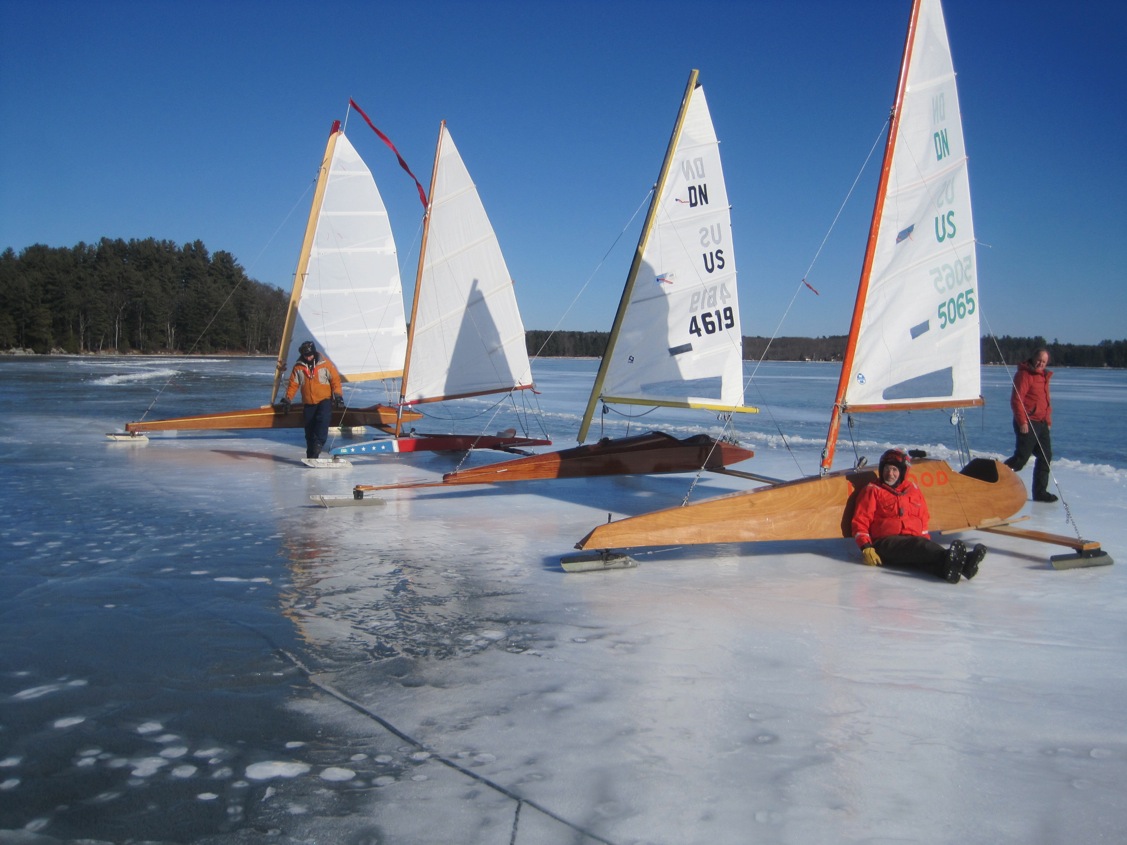
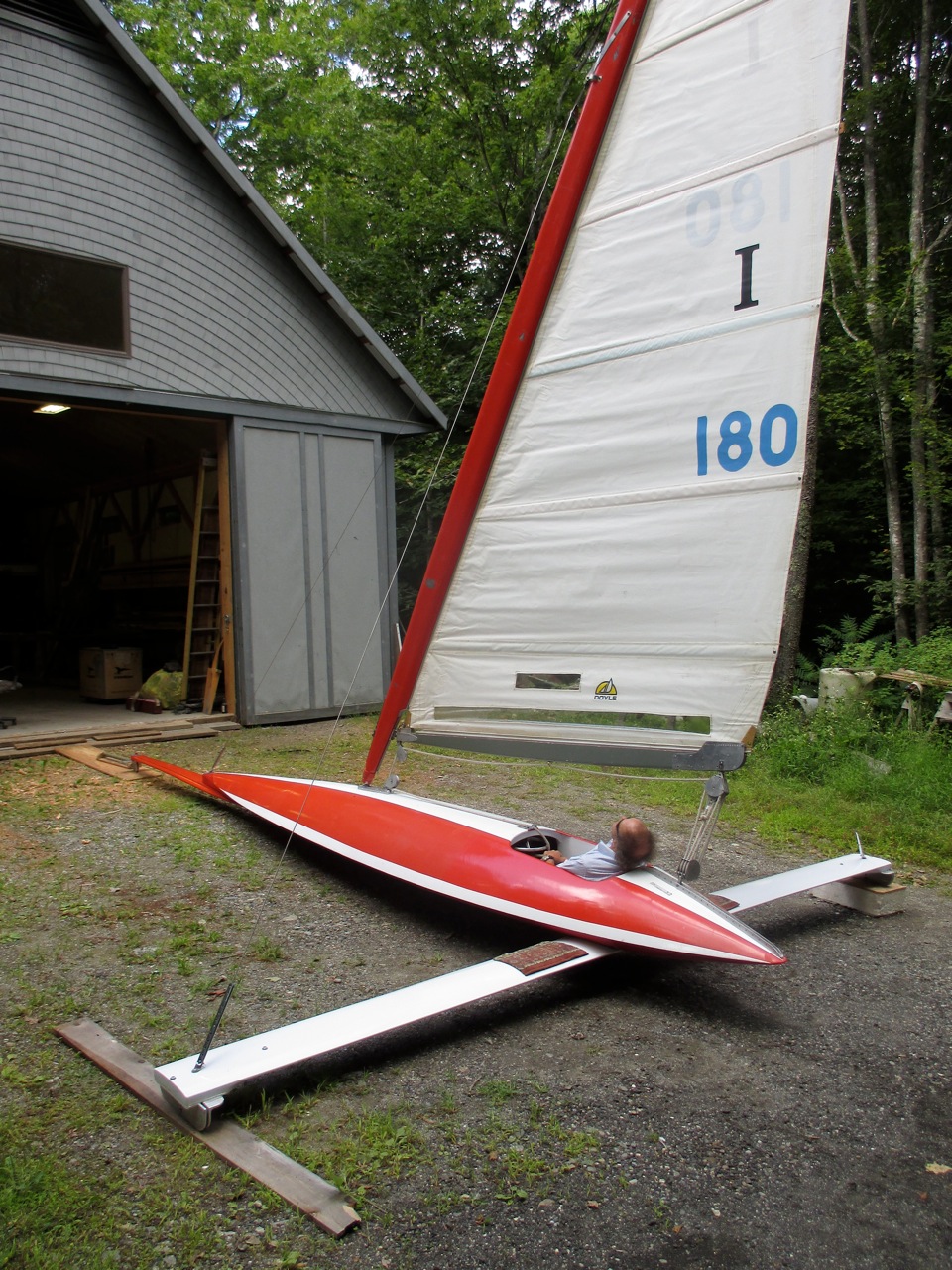
Our last post, describing the Ruge designed Hagarty skeeter, has un-earthed a thick file of articles written by him in the thirties and forties. This is the first in what will be a weekly series of articles written by Mr. Ruge here in the tail end of the off-season.
Apologies to our stern-steering buddies, both here and abroad, for any slights obvious or inferred, as there are quite a few! Then, as now, there’s room for everyone out on the ice.
Best wishes to Lloyd Roberts, who’s recovering nicely from heart surgery last week. Reports indicate he’s THINKING ICE!
Time was, not so long ago, when the real iceboat fan had to be either a millionaire, able to pay hired professionals to rig and sail his boats, or else a confirmed lover of discomfort and hard work, willing to suffer strains, bruises and frostbite for a few days of sailing on ice each winter.
Boats were big and heavy, simply because no one had been able to design or build a small one that would really perform. Size was considered synonymous with speed, until boats had actually attained a length of over 50 feet, and spread anywhere from 500 to 1000 ft.² of canvas. A good 6 inches of ice was the least that could carry them. The time-honored sloop rig had proved its superiority to the cat and the lateen, and was used almost universally. The Hudson river type of boat, though she racked and twisted and often spun out dramatically, was accepted as the pinnacle of iceboat design. Discomfort while sailing, a cramped, twisted driving position, completely exposed to the bitter wind, was accepted as inevitable. For how else could an iceboat be built? And the number of prospective fans who found one ride under these conditions to be all they could take was legion. Iceboating was not popular for the simple reason that it couldn’t be made reasonably comfortable, reasonably inexpensive, and reasonably accessible.
Today, iceboating is growing rapidly. New clubs are being formed each season, and the older clubs report a lively increase in membership and activity. The summer sailor is finding a way of sailing all winter and of getting 1000 thrills that his waterborne craft can never give him. Every winter weekend sees cars by the dozen pulling up beside mountain lakes -ten, twenty or sixty miles from town, wherever there’s 3 inches of ice- with iceboats on the roof or pulling them behind the car on trailers. And these are not toys. They are fast, sturdy racing boats. Light, simple, comfortable to drive, and able to trim the huge champions of past years with amazing frequency.
What has happened? What took out the hard work, the physical suffering, the lack of interest by all but a few hardy souls? Several things- and they all came at once.
The aviation industry showed us how to get rid of mass and weight; how to streamline and even how to cut a sail. It gave us aluminum, airplane spruce, stainless steel, tiny wire and turnbuckles that will stand thousands of pounds. It taught us how to build up laminated wooden members for lightness and strength. It gave us the idea of a streamlined fuselage, with only the pilots eyes and forehead showing. It gave us the boat we sail in, almost from stem to stern, and it gave us the clothes to wear to sail her: flying suit, helmet, goggles and all.
The automobile industry grew so fast that roads had to be improved. Cars were no longer laid up in mothballs at the first frost, but were expected to give service all year round. The highways were kept open regardless of weather. Then someone built the first trailer, and the iceboating enthusiasts discovered that, instead of waiting in their own backyard, all they had to do was lash the old hooker on the trailer to go to the ice.
Sailing on the water continues to grow every year. It has given us any number of improvements in rigging, sailmaking, etc, but its greatest contribution has been to awaken a love of sail and spread it to every lake and pond in the country. More and more numerous, and more and more youthful are the sailors. Small wonder that they have responded to the chance of sailing all winter, too.
Then these water-bound, rule-bound sailors discovered that they have miraculously left all design restrictions behind. Here, in iceboating, was that long awaited chance to try out all their pet ideas, and what sailor worthy of the name doesn’t cherish a few? They found they could build anything they liked, yet were permitted to race against other boats – no matter how long, short, wide, or narrow they might be – just as long as their sail area was the same, and their brainchild was not considered unsafe by the regatta committee. It was natural enough under these little rules that no two boats should look alike. And, with the recent tremendous increase in the efficiency of rigs, plus lightness of hull, it is now possible to design a really small iceboat that is not a toy but a capable racing craft able to sail in light airs and carry a man as fast as any man could want to go.
At first, these design experiments followed the pattern of the Hudson River boats, with her rudder aft. And the typical wild gyrations of the stern-steerer when headed off the wind continued to be the rule; in spite of all the designers could do, skippers and crew were still wont to leave their craft for an impromptu slide across the ice. One such experience by the average beginner was about all he wanted.
Then, one wonderful day, someone built a boat that went the other way: rudder first! Lo! No spin! Even if you tried to make her spin she wouldn’t. The Meyer Brothers of Milwaukee, Wisconsin developed the front steerers in a famous series of racing boats in the early 1930’s. Among other things, they discovered that in the larger classes, over 175 ft.², front steers are dangerous in case of an upset and are extremely difficult to keep supplied with backbones. But the interesting fact remains that they were amazingly fast in all sizes.The Myers early boats were converted stern-steerers and carried jib and mainsail rigs. The cat rig never had been much good on an iceboat before, so why use it now? But these men weren’t satisfied with the action of the jib on the front steering boat. They tried the cat rig. To get the center of effort far enough aft they raked the mast until she looked like a bugeye. Everybody thought they were completely crazy, which usually seems to be a good sign. She licked everything in sight so badly that they are still talking about it, and nowadays a front steerer with anything but a sharply raked cat rig looks out of date, and doesn’t usually finish in the money. The combination of all these developments has given us the little speed sleds of today and has caused a tremendous upswing in the number of devotees of iceboating. More and more the interest centers in the smaller classes; only on rare occasions do the big ones get out in the East and, although the few fine big boats continue to scrap between themselves for the Hearst and Stuart Cups in the Midwest, the action today is with the smaller bow-steering classes. In Wisconsin, skeeters (75 ft.² of sail) outnumber all the larger boats put together.
It was natural that racing should be the most popular occupation of the iceboatmen. Some attempt to standardize racing classes has been made in each district where the sport was enjoyed, but not until recently were the differences between the East and the Midwest ironed out. The Northwestern Ice Yachting Association, which includes the leading clubs in Wisconsin, Michigan, and Illinois, had accepted the rise of the Skeeter and, by 1935, was conducting annual championships for four recognized classes: class A 350 ft.², Class B 250; class C 175; and class E, the now famous Skeeter 75 ft.². The fifth division, class D, 125 ft.², was recognized unofficially.
However, the situation in the East, where iceboating is enjoyed at many widely scattered points, was entirely disorganized. The greatest activity was in a small area, practically a circular arc centering in New York City and with a radius of about 50 miles, which included the Shrewsbury River area at one end, swung out through northern New Jersey to take in Lakes Hopatcong and Musconeteong, hit the New York State line at Greenwood Lake, and finally arrived at the Hudson River via Orange Lake and the city of Newburgh. It also strikes Lake Ronkonkoma and Great South Bay on Long Island. Points outside of this are seemed to get too much snow for much real boating; inside it there were no lakes of any size. Here was a surprisingly concentrated area, yet no effort had been made to get together and do something about it. Finally the idea of an Eastern Association was born, and after a few months of talking about it, representatives of five or six leading Eastern clubs met at Larchmont, in November 1937, and formed the Eastern Ice Yachting Association. All the classes of the N.I.Y.A. were adopted by its eastern counterpart. In addition, class D of 125 ft.² was made official and one extra class, a long established Eastern class B of 200 ft.², was recognized and allowed to keep its time-honored name. Accordingly, the 250 footers were dubbed class X, though they correspond exactly to the Northwestern’s class B. This gives the Eastern fan six classes to choose from, four which are also recognized in the Northwest. It is not improbable that intersectional racing may soon be revived, at least in Class E. Meanwhile, both associations conduct annual regattas and award championships in all their recognized classes.
Assuming that the bug has bitten, the questions that immediately arise are these: shall I join a club? What class so I get into? Shall I buy a used boat, design and build my own or buy from a professional builder? What will it cost? The answer to number one, Shall I join the club, is emphatically Yes. Advantages to be gained are many, and the expense extremely small. For not only do the attractions of congenial companionship and organized racing present themselves, but all the other questions of the average beginner will be more satisfactorily answered if he joins a recognized club. The answer to the next question, What class shall I enter?- will depend largely on what is the prevailing class in your club. The one exception to this might be in the case of the oldest and largest of the clubs who’s fleets grew up in the good old days and who’s boats therefore are mostly big and heavy. In this case it would be more advisable to adopt the ever present Skeeter and, if necessary, pioneer her for a while. You won’t be the only Skeeter owner for long!

WordPress.com