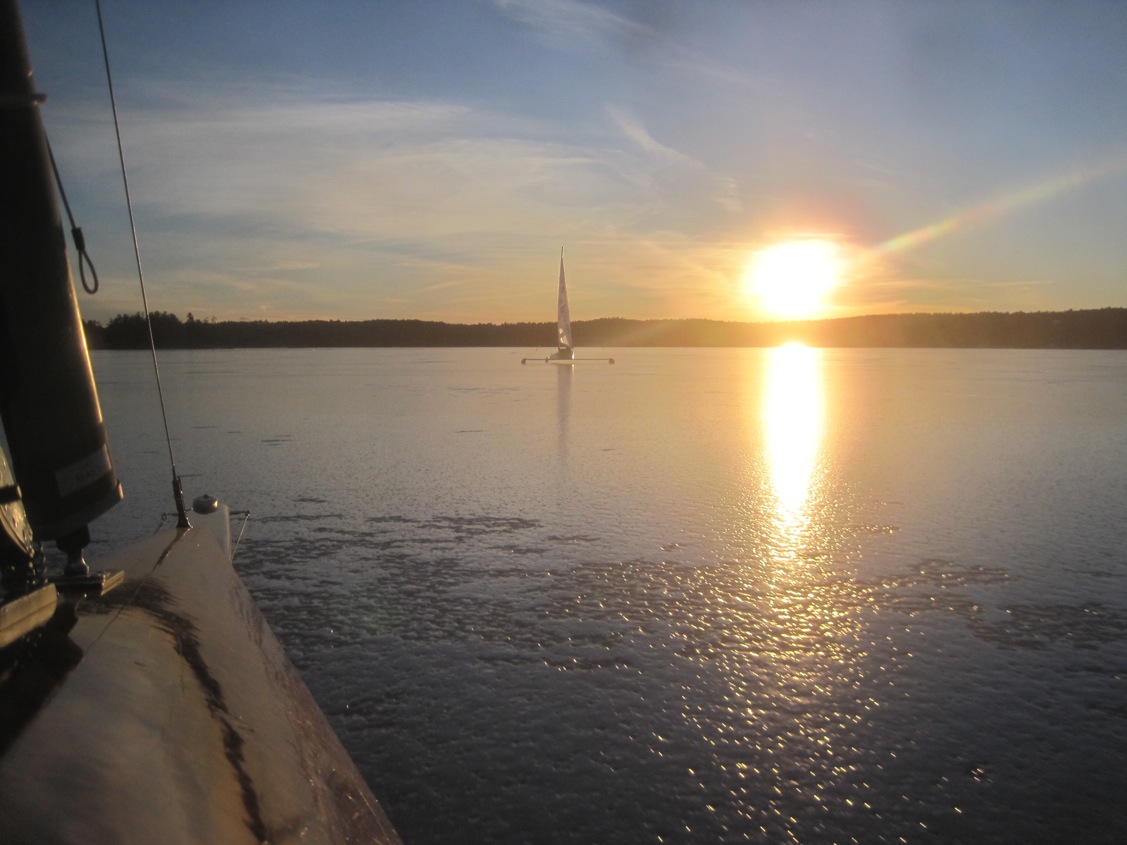
Un-healed slushwich and marginal surface on Lake Megunticook this morning. Damariscotta webcam, though, shows some promise. We’re heading out now with boats to look.
Search Old Posts
-
Join 2,250 other subscribers
Past Seasons
Un-healed slushwich and marginal surface on Lake Megunticook this morning. Damariscotta webcam, though, shows some promise. We’re heading out now with boats to look.
“Drive by report” (from breakfast table). An inch + snow on ground here after lots of rain, almost 2 inches. Lake looks like butterscotch swirl ice cream, partially wetted out. Swimming hole larger, I think 3 of the 4 marking buoys have blown away or sunk. Forecast small low pressure systems passing through into next week do not look like good ice building news, maybe a little rain/snow.
We sailed on Darmiscotta on Wednesday. As I drove down the totally snow-free boat launch ramp, I could sense that the four foundations of iceboating were present: Good wind, good buddies, beautiful ice, and a lovable venue. I couldn’t wait to set up “Ice and Easy”, my new mini-skeeter, which I had yet to sail in strong winds.
The ice, though it was reformed after a few weather cycles, was at the very top of our rating scale. We sometimes call it “Pushaw ice”, reminding us of a magical series of days we had there two seasons ago, Present were Bill, using his whizz class “whizzard” with a full whizz sail—and not a DN sail– for the first time this season; Guy, with Dickie’s old DN, which, with Guy’s years of soft-water racing, becomes a very competitive combo; Bob who, though astride his humble Cheapskate, is one of our most adventurous and consistent buddies; Jim Gagnon, with his super-DN, newly repaired after dropping a runner in a hole on Cobboseecontee; Jimmy Mathieu, in his beater-DN; and finally Doug Fowle with his faithful, much modified, Lockley Skimmer.
Releasing my emergency brake, Ice and Easy, without the slightest push, began to gain speed to the South in front of the NW wind, across the glassy surface. I haven’t had this boat long enough to ruin the impeccable alignment of its runners, so it moves with an ease I have never experienced before. The group quickly regrouped a quarter mile to the south, around the first of our discovered hazards: a hole the size of a motorcycle with absolutely no warning. There was no brash-ice was around its rim. Only its darker color amid the variety of lighter-colored ice gave it away. Lying prone in an iceboat, a pilot traveling faster than a jog, would be a sitting duck. We soon discovered a few more of these beauties, and Jim Gagnon, as though to test their reality, promptly—thankfully at slow speed– dropped his runner into one! Yes, Matilda, that is real water there.
Sometimes we sail on ponds whose limited size allows us to scout them totally. On ‘big ice’, sometimes we can find a pattern to its hazards, and thereby avoid them. But being on big ice with truly random hazards leaves us three options: Come back another day; explore a part of the ‘big ice’ thoroughly until we are confident, and do restricted, perhaps lower-speed sailing; or thirdly one could, as we say, “Channel Larry Hardmann”. Larry was a pedal-to-the-medal early member of the club, whose sailing knew no limits. I can’t remember exactly how he died, but I know it was by drowning. And here on Darmiscotta, one could sail at break-neck speed off into the cloud-speckled early sunset across a fetch of 2 to 3 miles, over ice so smooth that the only sensation was of flying, and of fearful exhilaration, meanwhile chanting to yourself some variation of the popular song, “I know this is stupid. I know this is hard on others. I’m doing it anyway!”
And here’s where sailing with buddies comes in: you have a much better chance of taking one of the first two options, the second of which we, in fact, did. And that less-extreme option–it was helpful to learn–was an absolute blast. We gradually got to know the northeast corner of the lake and could tentatively pull the strings a little harder. But the wind was building, old go-fast habits were beckoning, and the thought of dreary hours of boat-rebuilding was ever-present. So by 3 PM, we called it an early day and began de-rigging.
I will mention a few impressions of the mini-skeeter. This craft was designed by John Eisenlohr, with sails by Sailworks, and built by Bill Buchholz. It weighs 72 pounds and can be easily car-topped, which, if you’re fed up with trailers, is nice. The free-standing carbon mast comes apart in the middle. The sail’s luff sleeve is slipped over the mast and the mast inserted into a reinforced tube on the foredeck. The boat is competitive with a DN in terms of speed and windward ability, but more comfortable in terms of enclosure, sheeting and foot steering. Sail trimming, with lots of blocks and little friction, is effortless. I figured that this is probably the last iceboat I will ever own, so I just bit the bullet and got it. So far, I haven’t the slightest second thought.
So, buddies, with a little luck, we may survive this mixed precipitation and have another hard surface by the weekend. So far, the season, is shaping up beautifully.
It was unanimous: Bo Derek, Pushaw, whatever, it was again a 10. Even with 10-12mph winds, the runners ran silent. Downside were the numerous drain holes, which were expected. The surface, however, recovered from the rain in spite of above freezing temps all night. The drain holes did their thing perfectly, and kept a black skim on them so they could be seen. While a few of us were tip-toeing our way around and marking holes, Bob MacEwen took in the big picture and covered pretty much the entire North Broads in his multi colored Cheapskate. He came back to report that there were plenty of holes, but you were ok as long as you didn’t sail over them. I’m still wondering if this is simplistic or profound. Some one didn’t get the memo:

As the wind built and our confidence grew we actually began to sheet and wind up. It was a mile-a-minute day for sure, without even trying.

We planted sticks in the worst of the holes. If we’d had more time we would have set up marks as the plate we secured made a nice course. Guy will now be the keeper of the marks and organize their set-up next time.

The Mini Skeeter sailed very well in her first fresh breeze day. Never a hike, more than enough speed, good pointing and total comfort. The fellow in the cockpit there couldn’t be more satisfied. Both Jims took her for a sail and were impressed. Now we’re waiting for Frank and MS #33Rolling Rock. Frank, if we can get Megunticook for you on Saturday could you make it? Megunticook looks like it will get rain, not snow in the big storm tomorrow. Deep cold and drainage Friday might fix her right up beautiful. Pencil it in! We’ll scout it Friday and post it here.
Last night’s warm 50 F rain melted about an inch off the top leaving vast expanses of glassy wet ice, a few puddles maybe 1/4 inch deep, and small drain holes, fist size. The varied crystalline structure of the black ice, crystals often a couple of feet across, was accentuated by a haze of fine bubbles. These seem to be caused by sun light as they were much diminished under a marking buoy. The open swimming hole is larger than yesterday, threatening to eat a couple of the marking buoys, which don’t float. It was on a day like this that I took the cover photo on “Think Ice”, a perfect DN reflection. The public beach access is buckling down into a deep puddle for some reason. I felt a bit uneasy on the now only 4 inches of slightly punky but very slippery ice. Coolth is needed.