Wooden Boat Show Ticket Discount

Here’s some late breaking news from Commodore T at the NEIYA:

For those of you who have an interest in classic yachts of all types be sure to check out the WoodenBoat Show at Mystic Seaport from June 27-29. There will be enough slick woodwork there to make anyone drool….

Your commodore will be there fawning over the mighty NEITH, the newly restored 1907 Herreshoff sloop I look after- come and say hello- wear your helmet so I’ll recognize you!

We have arranged a discount on tickets for NEIYA and CIBC members. This was John Stanton’s idea (buy him a cold one sometime) and made possible by the shop that did the refit on NEITH; a great shop called Taylor & Snediker Woodworking.

If you want to attend and want a discounted ticket email me at t_thieler@yahoo.com

and I’ll send you the secret instructions…. Looking forward to seeing everyone there!

Website here:

The WoodenBoat Show at Mystic Seaport

Posted in 2014 Season, 2014 Season1 | Comments Off on Wooden Boat Show Ticket Discount

racing

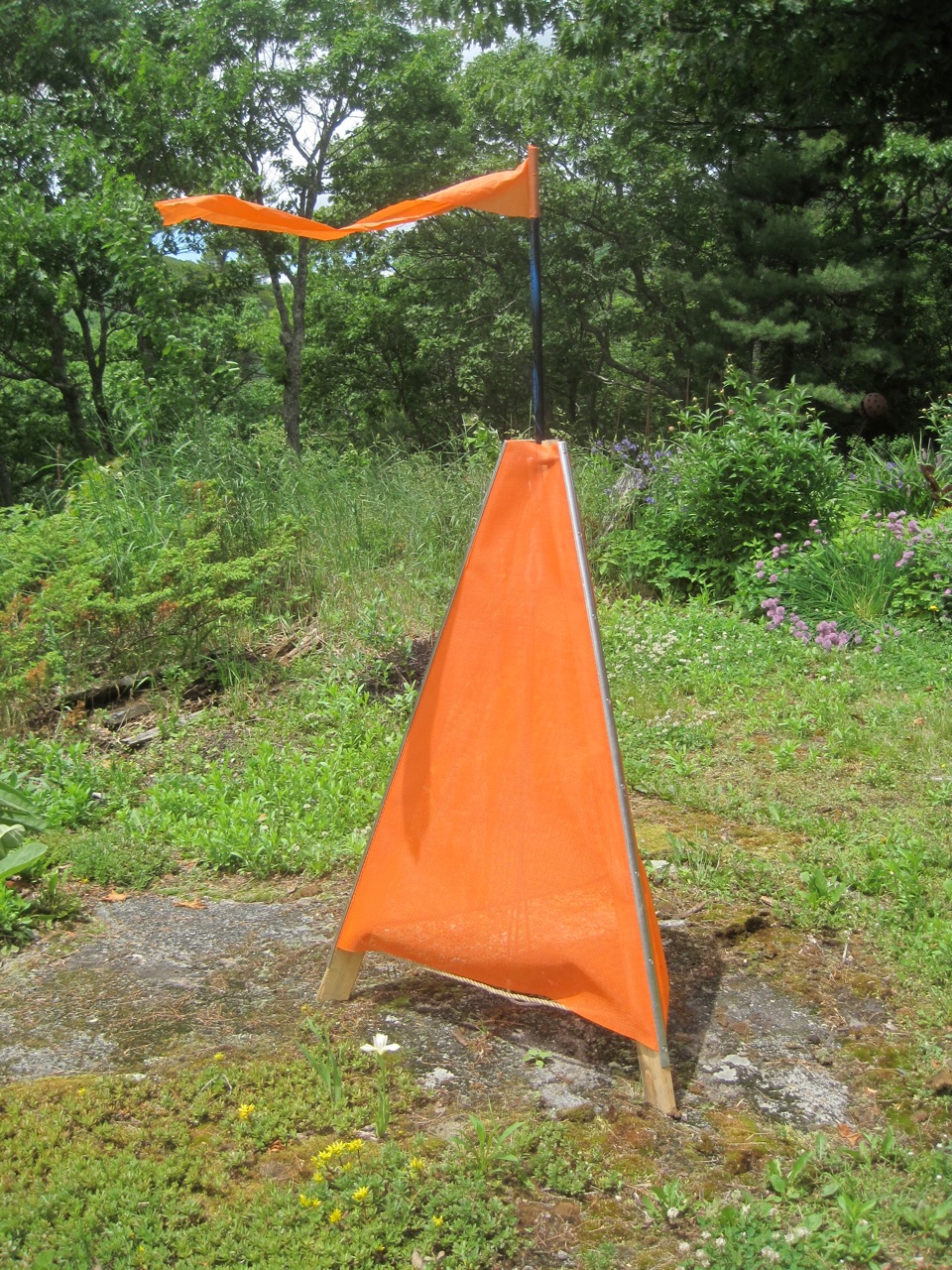
The last racing I can remember on Lake Chickawaukee was a couple of years ago when Andre Beby and a gaggle of Canadian buddies came to visit. We offered the usual cones for marks, but they suggested we use theirs instead and proceeded to set up really first class marks. They folded flat and could be lashed to the plank, were bigger than a cone and were secured with an ice screw and down-haul tackle. Not only that, but they kicked our butt. Fortier gave it all he had, but was having an off day, Lloyd wasn’t feeling up to it, and I’m a middle of the pack guy on the best of days. It must have been the marks.

So we put together a set this past Father’s Day. And not even the Canadians have telltails!

There was some great scratch racing on Damariscotta this past March, and I have a sense that the racing bug might be coming back to the CIBC. Spotting fish shacks and islands as marks works well enough if everyone can see them, or understands which fish house, exactly, is to be the mark. One memorable race had Bunting sailing over the horizon to some distant shack while the rest of us got our laps in and waited for him at the finish line: two channel markers.
Not that we want folks to take it too seriously, at this level, anyway. But Lloyd keeps hammering home the fact that racing builds sailing skill, and you need skill to sail an iceboat well. Sailing well means you can get to that remote cove, and then get back again, and have a great time doing it.

Posted in 2014 Season, 2014 Season1 | Comments Off on racing

Passing It On

The death of an old man is not a tragedy. It’s just the final act in a life we hope was well lived. He tries to tidy up before he goes, organizing his papers and disposing of things which he’d rather not burden those left behind. We all have our precious stuff, but at some point we need to be honest with ourselves about what we use and what we don’t. Such it was with a gentleman from Colechester, on the shores of Lake Champlain. He bought a brand new Arrow in the early sixties, the latest thing at the time. For over forty winters he sailed it with his children, friends, and those he loved to introduce to the sport. As a side-by-side two seater it’s a very social boat.

But as our fellow found his body failing and the Arrow used less and less, he considered it time to pass it on. Through our iceboat network the possibility fell into the laps of a wonderful couple who’d been out with the club a number of times this past winter, sailing whatever boats were offered. It seemed the perfect match. They travelled to Vermont this past spring, brought the Arrow back to Maine, and the gracious skipper of so many winters died just last week. Another small torch has been passed, helping to keep the larger fire of iceboating passion alive.

Posted in 2014 Season, 2014 Season1 | Comments Off on Passing It On

Some History

Taking the cue from the NEIYA on posting a bit of history now and again, here are some interesting tidbits clipped from the Grand Traverse Ice Yacht Club:

1896: Kingston Ice Yacht Club forms in Ontario, Canada. The active members’ own twenty-six stern steerers sporting from 325 to 725 square feet of canvas sail. The club deeds the Walker International Challenge Cup for Ice Yachts. This trophy donated by the distiller Hiram Walker & Sons, Ltd. of Walkerville, Ontario, to promote ice yacht racing on Lake Ontario, the Bay of Quinte, and the River St. Lawrence.

1903: Stuart Cup trophy established for competition among boats with sail areas over 600 square feet. First bow steering ice boats sailed. Bow steering lessens spinouts or “flickers.” Biggest safety improvement to date in the history of ice yachting.

1913: The book “Iceboating,” edited by Herbert L. Stone, is published. He outlines various “State of the Art” gaff rigged stern steerer designs, and also the South Bay Scooter. Hotbeds of ice boating activity are the Hudson River, Orange Lake, and Lake Chautauqua in New York, the Shrewsbury River in New Jersey, Lake Champlain in Vermont, Gull Lake in Michigan, and Madison, Wisconsin.

1927: Lake Mendota and Lake Monona Ice Yacht Clubs, active before the turn of the century, merge to form the Four Lakes Ice Yacht Club in Madison, Wisconsin. First marconi rigged stern steerers sailed. Stern steerers transported to regattas via railway flat cars. Telegrams sent to alert racers that regattas are on.

1933: Walter Beauvois of Williams Bay, Wisconsin designs and builds the Beau-Skeeter, a front steering iceboat. Even with just 75 square feet of sail, it’s the fastest thing on the lake. Skeeter Ice Boat Club forms on Lake Geneva.

1936: DN iceboat design developed by Archie Arroll, Joe Lodge, and Norman Jarrett in a competition held by the Detroit News newspaper. The DN can trace its ancestry directly to the early Skeeters.

1946: Bill Sarns, a third generation machinist, starts ice yacht hardware manufacturing business in his parents garage at 18 years of age.

1947: Renegade one design Skeeter is developed by Elmer Millenbach of the Detroit Ice Yacht Club.

1950: E Skeeter class dominates open and free for all events at regattas. Hey day of the picturesque and grand stern steerers over.

1951: New Hamburgh Ice Yacht Club, inactive for 25 years for lack of safe ice on the Hudson River, turns custody and stewardship of Ice Yacht Challenge Pennant of America over to the Eastern Ice Yachting Association.

1954: First IDNIYRA “Annual Regatta” hosted by the North Star Sail Club and sailed on Lake St. Clair. Top five finishers are Jack Moran, Skip Boston, Paul Eggert, Bill Sporer and Bill Sarns. Bill Sarns again wins Scripps trophy in regatta on Lake St. Clair.

1960: Jane Pegel first woman to win the DN Annual Regatta. Arrow one design fiberglass iceboat designed and built by the Boston Sail Co. of Mt. Clemens, Michigan. Dacron fully accepted as the sail cloth of choice. Nylon, which replaced cotton, now obsolete.

1962: First set of DN plans, drawn by Bill Sarns, leaves North America for Europe. Kess Kortenoever, a former Olympic ice skater, builds the first DN in The Netherlands. Sodus Bay Ice Boat Club on Lake Ontario in New York State incorporates. Original club goes back to the days of the stern steerer.

1965: Chickawaukee Ice Boat Club forms to promote DN racing in Maine.

1968: Dick Slates of Pewaukee, Wisconsin designs and build the Nite. Two wooden prototypes built. Design refined and fiberglass production begins in 1970. Over 550 of these one-design, side by side boats to be built.

1971: Five European DN skippers come to North America and race in the Annual Regatta on Geist Reservoir in Indianapolis, Indiana. These are first transcontinental competitors in an ice yacht regatta. West System Epoxy first offered for sale by Gougeon Brothers, Inc. of Bay City, Michigan. In decade of the 70s, DNs supercede Skeeters as the most popular iceboat in North America.

1973: First intercontinental ice yacht regatta, the inaugural DN Gold Cup, sailed on Gull Lake, Michigan. Art Teutsch of New Baltimore, Michigan is IDNIYRA commodore. The wedge hull shape is introduced by the Estonians. Ain Vilde of Estonia wins first Gold Cup. Randy Johnson of Gull Lake finishes second. Iron curtain opens so that Vilde, Helmuth Leppik, and Endel Vooremaa can travel from Union of Soviet Socialist Republics to compete.

1988: Composite mast construction begins to displace the aluminum spar as the go fast secret weapon. DN mast weight and balance point specification introduced to minimize performance differences between aluminum, wood, and composite masts. Sending faxes replaces leaving messages on answering machines to alert racers about favorable conditions.

1989: Dan Clapp of Fair Haven, New Jersey, designs and builds the Skeeter “Coming Attraction.” The design is revolutionary. A canopy covers the cockpit in front of the mast. Other innovations reduce aerodynamic drag and total weight to a minimum
.
1996: Elmer Millenbach passes away. During his Renegade racing days, wins 15 of 17 ISA regattas entered, and every Northwest Ice Yacht Association Renegade regatta he enters. Ron Sherry founds Composite Concepts in his garage in Clinton Township, Michigan. DN mast specification changed to allow composite construction, wood no longer required.

1997: DN official construction specifications now evolved so that boat continuously improves. DN most popular iceboat in North America and the world because of ability to sail in wide range of ice conditions. DN ranks in top ten of all one design sailing yachts competing in a National Championship in North America. Present state of DN evolution allows senior sailors to compete successfully at highest level of Gold fleet.

2000: E- mail and internet bulletin boards become standard for informing racers of ice conditions and regattas

Posted in 2014 Season, 2014 Season1 | Comments Off on Some History

Iceboats in WoodenBoat

According to Paul Zucco, iceboats have been featured on the cover of WoodenBoat magazine six times since it’s founding. A little research into the long row on the top shelf confirmed this, and Doug Raymond was kind enough to throw in the missing issue.

The first issue was #14 in 1977. The cover girl was Freddie Krause’s COLD WAVE, and the article by Peter Burckmyer featured and interview with some of the Hudson river Lawrence family members. It’s all about the gaff riggers, fitting for the time when the magazine was all about pine tar and hemp. They clipped artwork from S. Calhoun Smith’s fabulous book “Iceboating”, probably at that time still in print. Find it if you can.

Then came the DN’s in #86, 1989. Joe Norton is interviewed and tells a good story about the boat’s development, state of the art and the future. He predicts exactly how Jeff Kent and others have come to use wood as just one part of a composite structure. WoodenBoat has started with it’s love-hate relationship with epoxy.

#92, one year later, takes us back to tradition with the South Bay Scooter. I don’t believe the Scooter folks had started building in fiberglass yet, but this is a terrific article, quite long by WB standards. There’s even a photo of puddle jumping, but I still can’t imagine how the sail generates enough horsepower to get the boat from the water up onto the ice.

Dan Clapp is the next cover boy in an early bubble boat in #110, 1993. WB is now all about high tech wood/epoxy composites and what a great boat with which to demonstrate it. On the cover, he’s passing Peter Harken in a rumble seat skeeter. That type always had difficulty getting the balance correct enough to actually steer, so the boats by Clapp and Tom Nichols dominated for quite a few years. Tom tells a great story of racing with the guys from the mid-west on Lake Champlain and the Easterners are just walking away from the mid-westerner’s rumble seaters. They called Buddy Melges back in Wisconsin asking him what they should do, but Buddy wouldn’t accept that his guys were getting beaten so badly by such an unusual design and just told them to try harder! The rest is history.

WoodenBoat #182, 2005 comes home to Maine to tell us about L.F. Herreschoff’s SLIPPER. She’s an early fuselage type stern-steerer with a marconi rig. Great photos by Dickie Saltonstall on a beautiful day on Lake Sebago illustrate Bill Bunting’s story, and there is a nice sidebar by Lloyd Roberts. Plans are featured, so you’ll be able to build one for yourself if so motivated. It is iceboat building season, after all. SLIPPER was seen sailing on the Hudson this season, but we hope to see her back in Maine someday, too.

And another fuselage stern-steerer with a big steering wheel is the most recent, this past January. Great photos were taken by Alison Langly that day in 2013 just in case some one might do an article on the Monotype. Bunting twisted my arm pretty hard to get me to write it; I owe it all to him, thanks Bill. The funniest thing, though, is that the photo at the head of the story prominently shows a hole in her starboard quarter. It looks like a bullet hole, and if you squint just right you can imagine that it’s actually a Sopwith Camel you’re looking at, just back from a flight behind German lines. But no, her mooring thawed out in a southerly gale and she swung around impaling herself on another boat’s runner. Another reason to remove your runners at night.

Think Ice!

Posted in 2014 Season, 2014 Season1 | Comments Off on Iceboats in WoodenBoat