Thetford Mines

I’ve had it: Just as we get ice,
the temperature climbs and climbs!
My ice axe tinkles paltry ice,
though best of all my finds
But I know that there’s an answer,
and we’re off to Thetford Mines.

You say you’ve never heard of,
that place called Thetford Mines?
Just point your car’s nose northward,
and start following the signs
And four and a half hours later,
you’ll spot the lake at Thetford Mines

I thought Maine was just as nifty,
as any iceman finds
‘Til the smokestacks of Republicans
blew heat from southern climes
And now my heart is yearning
for the ice of Thetford Mines

Thetford has a secret,
while our southern heart repines:
When winds blast from Alberta,
and the mercury declines,
The locals smile and cavort about,
on the lakes of Thetford Mines.

I’ll find a sassy French girl,
who dresses to the nines
Who cooks a wicked bouillabaisse
with a broth of lemon rinds
In her cottage on the ice-edge
in little Thetford Mines

So we’ll leave you ice-nuts languishing
in endless weather binds
Bill and I’ll come limping back
when summer’s on our minds
To bathe and tell you fables
of the ice at Thetford Mines

Posted in 2014 Season, 2014 Season1 | Comments Off on Thetford Mines

November on Plymouth Pond.

My basic expectation of any ice season is to be on Plymouth Pond on December 8. And on average, that is usually about right. So today, I was settling into a lovely afternoon nap when the phone rang. It was our wonderful new Plymouth spy, Tim Smith, who had just chopped a 4″ hole thru solid ice at the landing. I immediately called Bill.

Jory: I have crushing news! Do you have a handkerchief handy?

Bill: Wait! let me sit down a minute! Death in the family?

Jory: We missed Plymouth Pond! 4″ of black ice!

Then recriminations flew back and forth about exactly whose fault it was, until, with a sigh, it became clear that we were equally asleep at the switch. 1:40 PM….what to do? Get the hell up there! So we sped up north at high speed, telling Plymouth Pond stories and eagerly looking for the landmarks…..dixmont, home stretch….the water tower, one more hill….and there it was, grey in the afternoon sun. Driving by, it looked like Moby Dick’s old whale hide: drain holes, orange peel surface, sticks and stones. I half expected a harpoon to be lodged at an angle.

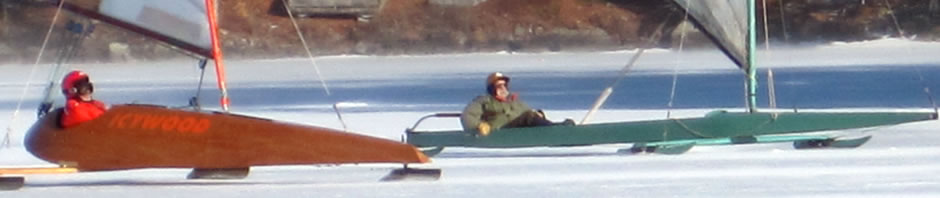
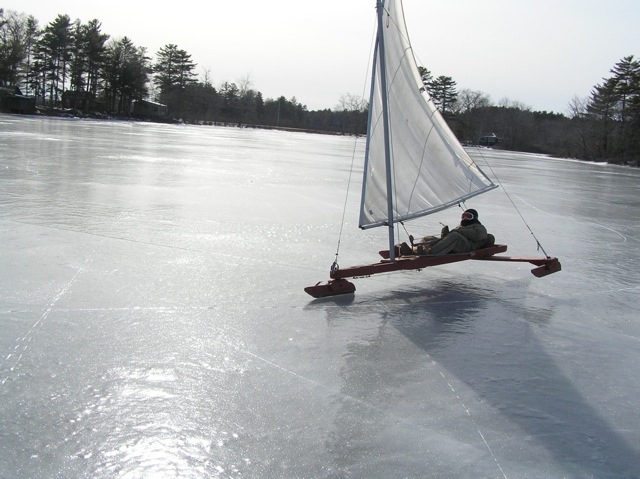
But Tim was right–a solid 4″–so we strapped on skates, Bill assembled his Skimbat, and we started swinging our ice axes, as we made our way out into deeper water.   Hooray!  After weeks of piddling ice,  something was solidly talking back to our swings!  Soon we came to smoother ice, without orange peel,  which measured noticeably less than 4″:   2.5″!   Bill abandoned the skimbat, as our worries increased, and I headed back to the pits for a forgotten pair of claws.  This was not going to be bullet-proof ice!

Once we were back together again–Bill not having moved an inch in my absence– we espied two areas about 2′ in diameter, just faintly different from their surroundings,  which turned out to be only 3/4″ thick! We made a note to mark them later, and–still gripped by ‘early ice extasy’– continued on the 2.5″ ice to the South. We soon found that the ice was far from monolithic:  it was a potpurri of textures, overlapping plates, and brash ice sandwiches; which occasionally measured as little as 1.5″ thick. It was almost impossible, in this variety of surfaces, to spot the ice junctions which are so vital to see and check.   Then,  a moment of  total panic set in:       It suddenly  seemed like we were surrounded on all sides by dangerous, unknown, unpredictable ice.  A high-stakes roulette game with nasty odds.    We gingerly turned around and, inspecting the glassy black ice carefully,  exactly followed our skate scratches back to the launch area, where we skated and skimbatted safely  in the light air, keeping to the 2 acre patch of 4″ thick orange peel ice.

As the sun set, we packed up and headed south, thanking our stars that we had not, after all, missed Plymouth. Plymouth at this stage is a disaster ready to happen.   There was no pre-season free lunch.   But she’ll probably be waiting for us, after this next warm spell, with the better kind of adventure we so long for.
Posted in 2014 Season, 2014 Season1 | Comments Off on November on Plymouth Pond.

Almost skating…..Rain a’coming

i have to admit: i love checking ice. what a great way to blow a morning, when, in all probability, there’s nothing happening. Just sitting on the edge of grassy pond, looking out on a whole pond with 1″ of newly-minted ice. Can’t i invent some machine with long, triple runners, a weed-wacker engine and spiked drive-wheel to blast across this virginity?

for the locals, here’s what i saw:

howe hill swamp: old ice=1.3″ new ice =.75 (estimate since i couldn’t cross the old ice) hobbs pond, near fish pond connector: =1.2″ lovely ice
whitetail reflecting pools: shaded ice=2″ (could be skated) open ice =1″ toleman pond: =1.7 (could be skated by midgets with 3′ nordic skates) grassy pond: =1″ very nice ice about to be kyboshed by warm dastardly weather megunticook, bog bay: old ice =2″ could be skated) open ice=.8′ megunticook lake main body= open water
plymouth pond, as reported by your pie-in-the-sky plymouth store: open water

so, shall i go out in the weak yellow 1PM sun and skate those paltry slivers of ice? or, loaded with thanksgiving leftovers, drift off into la-la land. you guessed it…..ZZZZZZ

Posted in 2014 Season, 2014 Season1 | Comments Off on Almost skating…..Rain a’coming

Earliest Ice

EARLIEST USEABLE ICE

A few cold nights and frozen puddles and we are digging out our skates and sharpening runners. When will it actually freeze enough to skate/sail on?
The easiest clue is to listen to NOAA radio. The key is “mean daily temperature” strangely enough this needs to be 32F or below. In order for big enough ice to use to freeze these cold nights we need to have little or no wind… forecast “light and variable”.
Some 50 years ago when my high school hockey team played on natural outdoor ice (talk about “hardship of the old days”) I was the team manager and responsible for the ice. The main duty was flooding the rink at night for fresh ice the next day, my middle name was Zamboni. We only flooded when the temperature was below 20F. In reality for useful new ice to form or “skim over” the temperature needs to be nearer 10 than 20. If it has been cold snap “Canadian High” cold for a day or two it has likely been NW windy as well with the front coming in. About the third day of the high we can expect the “light and variable” wind to allow skim it all over seize up as the surface water has been cooled and maybe supercooled to 32 or below by the wind and cold air. When the daytime temp is less than 10 and no wind expect real action. I have seen Chickawaukee freeze right over in the middle of the day, you could see the ice grow. Then you can get 1/2-3/4 inch overnight growth and the real stuff. Beaver ponds and frog puddles will jump the gun and Jory will find them.

Right now, Black Friday after T’giving, two cold nights and daytime 30’s may have the beavers holding their breath but so might we.

Iceman

Posted in 2014 Season, 2014 Season1 | Comments Off on Earliest Ice

CHEAPSKATE, The Iceboat, by Lloyd Roberts

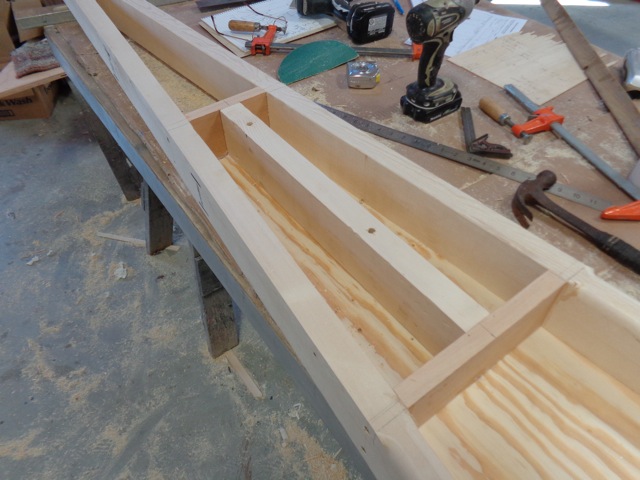
The Alcort Sunfish empire began with a commercially unsuccessful ice boat design, some 50 boats made in the early 1960’s. CIBC member Al Heath bought one from Uncle Henry’s some years ago and has been sailing it hard and maintaining it little for many seasons. It sails well with un-modified Sunfish spars and sail, and is made from a few sticks of wood, ply, nuts and bolts, and angle iron runners.

The CIBC brain trust felt we should build a replica to tempt soft water sailors onto the hard stuff and a healthy ice addiction. Bill Buchholz of Apache Boat Works, Camden, was contracted to construct the craft forthwith.
Forthwith turned out to be 4 hours for the bare fuselage, the big bang. The space time continuum expanded exponentially to five days and $150 worth of materials, lumber yard 2 X 12, a bag of 3/8 ordinary shiny bolts, not even hot dipped galvanized let alone stainless, Titebond III glue, no epoxy, bits of plywood from around the shop, bed frame rails from the dump for runner angle steel (much harder than cold rolled), aluminum plate bits from the junk box, and a hand full of wood screws.

A somewhat worn but serviceable Sunfish rig was applied to what looks like a streamlined life raft.

The expensive items of a DN are missing; no $1000 mast, no $1000 sail, no $1000 runners, no $1000 hardware package, no $100 4X8 sheet of ply wood and $100 worth of Sitka spruce, no $100 worth of Epoxy and fancy varnish.
The time continuum is in the neighborhood of 40 hours. The boat was removed from the Buchholz shop after the fifth day to stop the clock. Some little stuff remained to be done like sharpening the angle steel runners, freeing up runner bolt holes so wet swelling wood doesn’t end the sailing day on a sour note and so forth. The space continuum is garage/basement.
The boat will sail. The Alcort guys paid some attention to DN foot print, tiller/steering arrangement, sheet run, etc. The low aspect Sunfish Lateen rig of 75 Square feet (as much as a skeeter !) will have sufficient power. The 12 inch wide plank should support robust skippers. In case of mishap it will float, even the runners float. No need to retrieve the boat with a grapnel in the Spring as with a “Skimmer”.
The “Cheapskate” can indeed be built on the cheap if the skipper does the work. Basic shop and wood working skills nearer the level of bird houses than stripper canoes or kitchen cabinetry is sufficient. A Thanksgiving start and application evenings and weekends should get onto the ice by New Year. Plans and written guidelines will appear soon.

Posted in Cheapskate | Comments Off on CHEAPSKATE, The Iceboat, by Lloyd Roberts